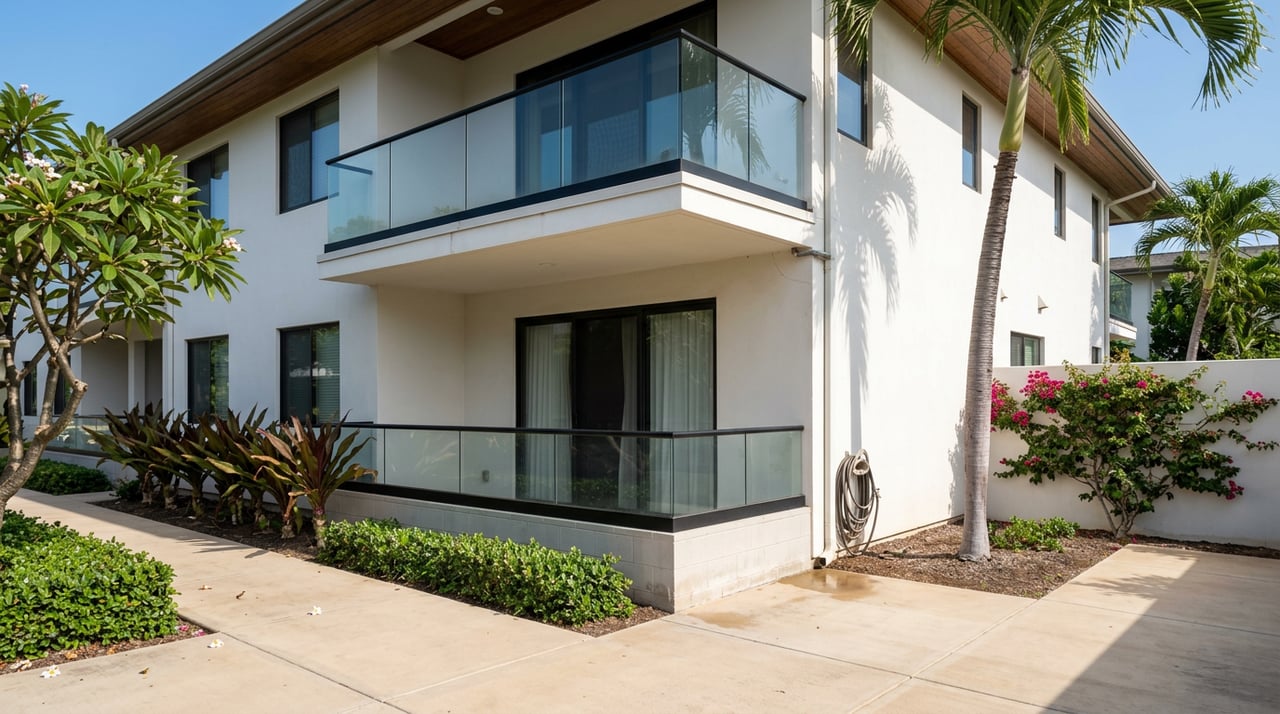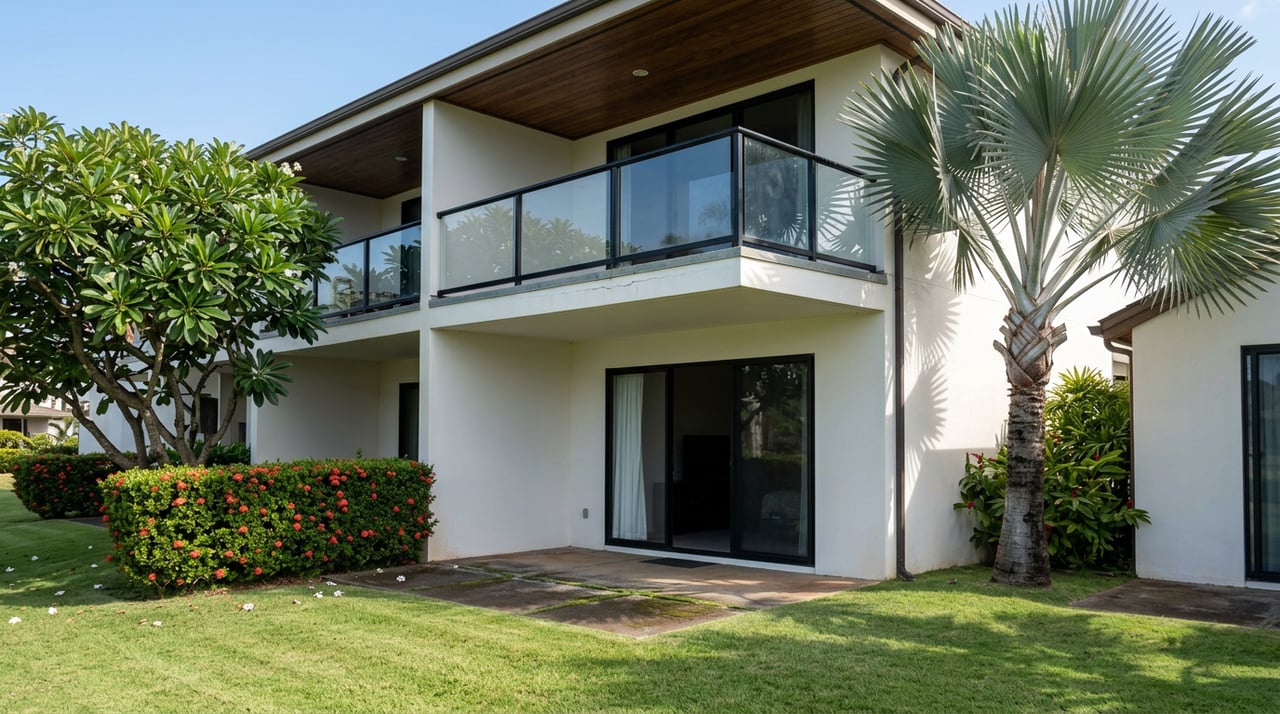
Two units at Grand Champions, similar layout, similar floor, listed forty thousand dollars apart. A buyer comparing them on price alone would guess their annual tax bills land close together too. They won't. One sits just under a line the County of Maui moved on July 1 this year. The other sits just above it. Same complex, same golf course view, different tax bracket, and nothing about the units themselves explains the gap.
That line is real, it moved recently, and it happens to run straight through the price range where Wailea's most accessible condos live.
The county redrew the brackets this fiscal year
Maui County sets new property tax rates every July, and this year's schedule, adopted under Resolution No. 26-69 and effective July 1, 2026, made some real changes to how vacation rentals and second homes get taxed. The classification that covers permitted short-term rentals, TVR-STRH, saw its rate climb in every tier: from $12.50, $14.00, and $15.55 per $1,000 of assessed value up to $13.00, $15.00, and $17.00. That's a rate increase on its own. But the more consequential change is where the first tier now ends. The county tightened that ceiling from $1,000,000 down to $900,000.
That hundred-thousand-dollar shift matters because of what it does to a specific slice of value. A unit assessed at $950,000 used to sit comfortably inside Tier 1, taxed at the lower rate on its full value. Under the current schedule, that same $950,000 assessment now lands in Tier 2, where the portion above $900,000 gets taxed at $15.00 per $1,000 instead of $13.00. Nothing about the unit changed. The bracket moved underneath it.
Non-owner-occupied properties, the classification covering second homes without a rental permit, saw a parallel move. Tier 1 rose from $5.87 to $6.25 per $1,000 and Tier 2 from $8.60 to $9.00. But the threshold that actually reshapes buyer behavior is the top tier: any non-owner-occupied property assessed above $2,500,000 is now taxed at $17.00 per $1,000, a bracket that used to start at $3,000,000.
Two lines moved. One sits at $900,000. The other sits at $2,500,000. Both happen to fall inside the price range where real Wailea inventory trades.
Grand Champions is sitting right on top of the first one
Grand Champions is the complex most Wailea agents point to when a buyer asks where to start. It's a 188-unit community on the Old Blue Golf Course, built with one, two, and three-bedroom layouts, and it's long been considered the entry point into Wailea ownership because its per-square-foot pricing runs lower than the beachfront communities nearby. As of August 2026, active listings there span roughly $850,000 to $1,700,000.
Look at where the new $900,000 TVR-STRH threshold falls inside that range. It isn't near the top or the bottom. It's close to the floor, meaning a meaningful share of Grand Champions inventory that would have cleared Tier 1 under last year's rules now sits in Tier 2 under this year's, assuming the unit carries a short-term rental permit and gets used that way. Grand Champions is one of the Wailea communities where that permit is common. A buyer comparing two units there at $875,000 and $925,000 isn't just comparing a $50,000 price gap anymore. They're comparing two different tax tiers.
The quieter line at $2.5 million
The $900,000 threshold gets attention because it sits at the entry level, where most first-time Wailea buyers are shopping. The $2,500,000 threshold gets less, because it sits higher up, but it falls in an equally specific spot.
Wailea Ekolu, the golf-course-fronting community with 148 units above The Shops at Wailea, tops out around $2,400,000 in its current listings as of August 2026. Wailea Elua Village, the resort's first completed condo community, starts around $2,700,000 in that same window. The gap between those two communities, roughly $2,400,000 to $2,700,000, is exactly where the new non-owner-occupied Tier 3 threshold sits. A buyer who assumed the $3,000,000 line from a year ago still applied, and shaped an offer around staying just under it, would find that line no longer exists where they thought it did.
It's worth remembering that Maui's tiered system only taxes the portion of value above a threshold at the higher rate, not the entire assessment. Crossing into Tier 3 doesn't mean the whole value gets taxed at $17.00. It means the slice above $2,500,000 does. Still, for anyone modeling carrying costs on a Wailea Ekolu-to-Elua purchase this year, that slice is bigger than it would have been twelve months ago.
Classification depends on use, not just the building
Here's the part that catches buyers off guard even after they've clocked the bracket lines: the tax classification isn't fixed by which complex you buy into. It's set by how the property is actually used, what the county calls its highest and best use.
Seven of Wailea's fourteen condo communities allow short-term rentals: Hoolei, Grand Champions, Palms at Wailea, Wailea Beach Villas, Wailea Ekahi, Wailea Ekolu, and Wailea Elua. Owning in one of those buildings doesn't automatically put a unit in the TVR-STRH bracket. A buyer who purchases at Wailea Ekahi and uses the unit only as a personal second home, with no rental permit and no rental activity, is classified non-owner-occupied instead, which carries a lower rate up to that $2,500,000 line. A buyer who holds a permit and rents the same unit short-term is classified TVR-STRH, subject to the tighter $900,000 threshold and the higher rate schedule above it.
The owner-occupied classification sits apart from both. It requires filing a home exemption, occupying the unit as a principal residence, and meeting Hawaii's 270-day residency and state income tax filing requirements. Most Wailea buyers, second-home owners and investors from the mainland, won't qualify for it, which is exactly why the non-owner-occupied and TVR-STRH lines matter so much to this market specifically.
What to check before you write an offer
A handful of questions, asked before the offer stage, will tell you which side of these lines a given unit actually falls on.
- Ask for the seller's most recent property tax bill, not just the assessed value on the listing sheet. The bill shows the current classification directly.
- Confirm whether the unit carries an active short-term rental permit. A permit changes the classification math even if you don't plan to rent the unit yourself.
- Model the annual tax under both classifications you might realistically use, non-owner-occupied and TVR-STRH, especially if the assessed value sits close to $900,000 or $2,500,000.
- Check the property's current classification directly through Maui County's public assessment records, which show the class on file for any parcel.
- Know the appeal window. Maui County's Board of Review appeal deadline falls around April 9 each year, so if an assessment looks off once you own the property, there's a set calendar for challenging it.
None of this changes whether a Wailea condo is the right purchase. It changes whether the number a buyer is comparing across two listings is actually the number that will show up on next July's tax bill.
A few common questions
Does any of this apply if I plan to live in the unit full time? Not in the same way. Owner-occupied properties with a filed home exemption sit in their own classification with different rates entirely. The $900,000 and $2,500,000 thresholds discussed here apply to non-owner-occupied and TVR-STRH properties, which cover most Wailea second-home and investment purchases.
What if the unit doesn't currently have a rental permit but I want to add one after closing? Adding a permit after purchase can shift the classification going forward, which is worth factoring into a purchase decision if rental income is part of the plan. The classification follows actual use, so a change in use after closing can trigger a change in tax class at the next assessment cycle.
Where can I verify a unit's current classification myself? Maui County's Real Property Assessment Division maintains public records searchable by parcel, which show the classification and assessed value the county currently has on file.
If you're comparing Wailea condos across these lines and want the current tax classification and history pulled before you write an offer, Christian Slocum can walk you through the numbers on any unit you're considering. Request a free home valuation or schedule a consultation to talk through what a specific price range actually costs to hold this fiscal year.